
X Another Deliberate Deception: Hiding the Big Hill Mess
In the last section, we assumed that the Big Hill SPR site is not currently operational and will not be operational until at least the second quarter of 2027. Whether Big Hill is operational – and if it is not operational, when it will be operational again, is a crucial issue because, according to the May 29, 2026 GAO report, Big Hill contains 90MB of oil. If and when Big Hill becomes operational, about 40 MB of oil can be drawdown. At 4 MB per week, Big Hill can provide an additional 10 weeks of oil price rigging – retaining the illusion of low oil prices until after the 2026 election. So one would think that getting Big Hill working again would be an extremely high priority. However, in this section, we will provide evidence not only that Big Hill is a Big Mess, but that oil industry insiders are aware of this fact and are deliberately hiding this fact from we, the American people.
We know this not only because the May 29 2026 GAO report said that Big Hill was out of action, but because the Big Hill SPR site did not receive an “award” of a single barrel of oil for any of the five SPR contracts that were issued during Spring 2026. On March 11, Trump stated he would release 172 million barrels from the Strategic Petroleum Reserve. Later, the US Department of Energy announced 5 contracts for this oil. But these contracts only awarded 133 million barrels of oil. Here are the 5 contracts in millions of barrels:
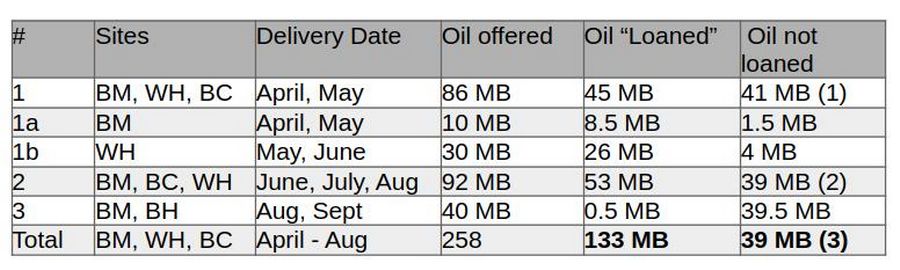
(1) 41 million barrels was reissued as Contract #2 and thus is not counted.
(2) 39 million barrels was reissued as Contract #3 and is thus not counted.
(3) 172 MB announced by Trump minus 133 MB awarded is 39 MB not loaned.
In each of Contracts 1, 2 and 3, there was about 40 MB of oil that was not loaned. This is what I refer to as “the 40 million missing barrels of oil” which is key to estimating the actual Tank Minimum and a major Red Flag that both our government and oil industry insiders knew in May 2026 that Big Hill will be out of action until 2027.
Assuming the SPR had 415 MB when Trump made his announcement, it is clear that Team Trump thought in March 2026 that there was 172 MB of oil left that could be taken from the SPR. Put another way, they thought Tank Bottom in the SPR was about 415 MB – 172 MB = 243 MB. But sometime between March and May 2026, Team Trump and oil industry insiders learned the truth about Big Hill because while Big Hill was included in the final two contracts, no oil from Big Hill was ever actually awarded and it is likely that no oil from Big Hill was ever actually bid on. Instead, the five contracts repeatedly confirmed that there was 40 million missing barrels of oil. Big Hill was where the 40 million missing barrels was located and it is likely that the oil traders involved in this scam knew that Big Hill would never deliver this 40 million barrels of oil and therefore did not bother to bid on this missing oil. This is clearly shown in the 5th contract in which the traders failed to bid on 39 million barrels of oil.
Here again is the May 29 2026 GAO Table:
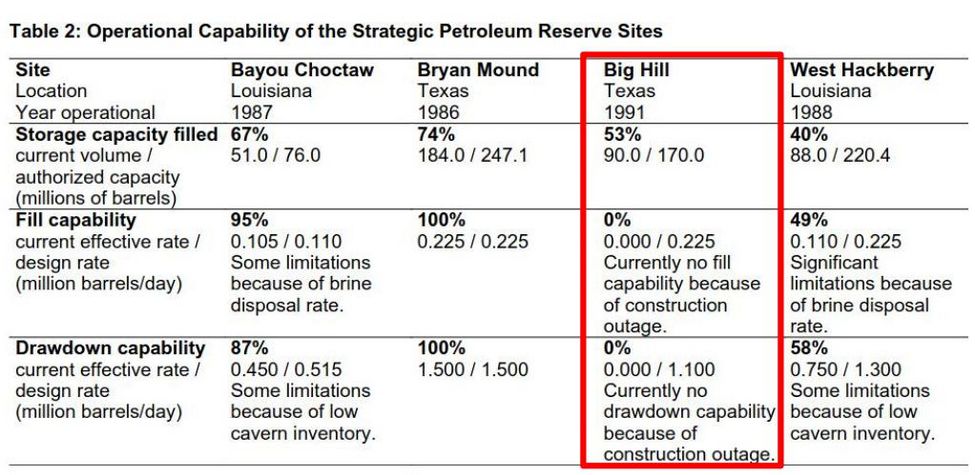
Note that Bayou Choctaw had only 51 MB of oil when the data for this table was reported in December 2025. Bryan Mound had 184 MB of oil. Big Hill had 90 MB of oil and West Hackberry had 88 MB of oil.
On August 5, the DOE provided further evidence that Big Hill was not operational in this form of this chart:
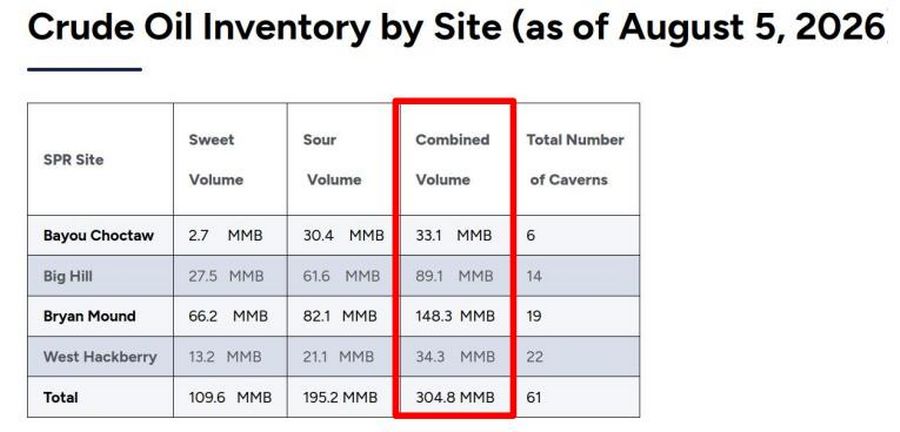
Some have claimed that the fact that the May 29, 2026 GAO report listed the volume of oil at Big Hill as 90 MB while the August 5 DOE report listed the volume as 89 MB is evidence that Big Hill is working. But instead, it is either a minor rounding error or evidence that the DOE is attempting to deliberately decieve the American people into believing that Big Hill is working when in fact it is not working.
Subtracting the August 5th volumes from the May 29 GAO volumes tells us how much oil was taken from each of the four SPR sites as of August 5, 2026.
Bayou Choctaw 51 – 33 = about 18 MB
Bryan Mound 184 – 148 = about 36 MB
West Hackberry 88 – 34 = about 54 MB
Big Hill 90.0 – 89.1 = about 1 MB.
Since August 5th, 6 MB was reported for the week ending August 7 and 5 MB was reported for the week ending August 14 for a total of 11 MB or about 294 MB supposedly left in the reserve. The entire 11 MB of oil was taken from Bryan Mound with about 12 MB of oil left to be taken from Bryan Mound to complete the final two Spring SPR contracts. Therefore, the final totals taken from the SPR by about September 4, 2026 will be as follows.
Bayou Choctaw = about 18 MB
Bryan Mound = about 36 MB plus 11 MB plus 12 MB = 59MB
West Hackberry = about 54 MB
Big Hill = about 1 MB.
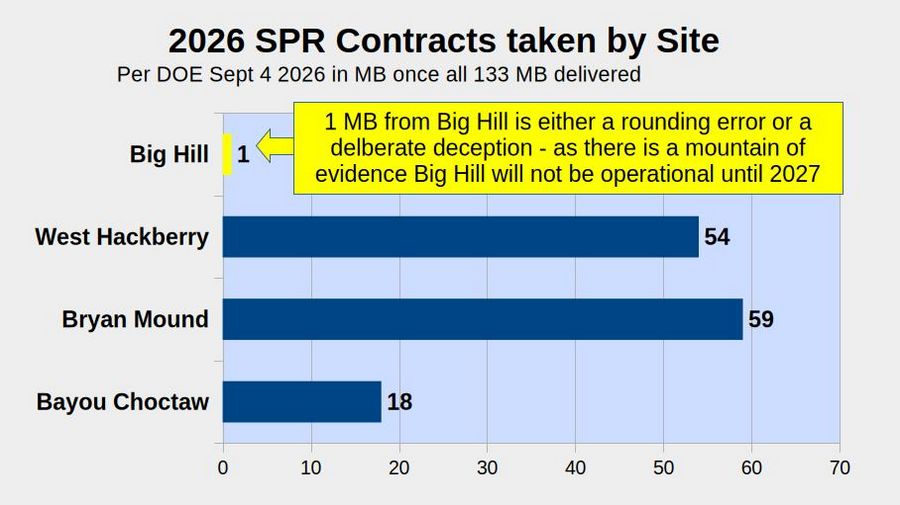
The final amount left in the SPR once all five contracts are completed will be about 305 MB from August 5th report minus 33 MB delivered in August and the first week of September equals 282 MB.
On August 17, 2026, the DOE announced that the SPR level as of Friday August 14, 2026 fell another 5 MB to 293.4 MB. This was the lowest inventory since December 1982. So as of the end of the second week in August, there are only 12 million barrels left until the end of the Spring contract awards. At 5 MB or even 4 MB per week, we are now only 3 weeks away from the fulfillment of all federal SPR contracts issued in Spring 2026. Even at 3 MB per week, we are only 4 weeks away from SPR Doomsday. So it is now looking like SPR Doomsday will be either the first or second week in September.
Why the 40 million missing barrels matter
Add 40 MB of missing oil at Big Hill to the 243 March 2026 Trump Team Tank Bottom estimate and you get a real SPR Tank Bottom of 283 million barrels.
My own independent analysis of 60 caverns resulted in a functional minimum of 280 MB
In addition to carefully reviewing the 5 SPR contracts, I conducted a detailed review of every one of the 60 caverns. This included using a range of estimated Tank Bottoms for each of the caverns based on the condition of that cavern.
I then added up all of the Tank Bottoms and my own careful independent estimate came to a total of 280 MB. The fact that the Trump Team estimate of Tank Bottom when adjusted for the absence of Big Hill closely matches the 2026 GOA estimate of Tank Bottom when using a 20% average cavern tank minimum both supported my own independent estimate that the functional bottom is about 280 MB. I am therefore extremely confident that 280 MB is the most likely functional bottom. There are only two variables that can affect this.
The biggest unknown is the actual condition of each of the 60 salt caverns and each of the 120 wells. This is not possible to know given that they are unstable salt caverns and extremely long wells being subjected to huge shear forces.
While some claim that Tank Bottom only requires keeping 10% of the oil in each salt cavern, my review of about 8 reports on the condition of the SPR written over the past 20 years leads to the conclusion that at least 20 of the 60 caverns have major problems and that a more accurate Tank Bottom is an average of about 20% of capacity.
Big Hill has a Tank Capacity of 170 MB and since 20% of 170 is 34 MB, then 90 MB current minus 34 MB Tank Bottom equals 56 MB as the most that can be taken out of Big Hill even if it was operational.
If we leave 20% in the other three sites, these are Bayou Choctaw: 11.4 MB, Bryan Mound, 37 MB and West Hackberry 33 MB for a total of 108 MB. Add this to 170 not available from Big Hill and the functional minimum would be 285 MB just from the GAO report and not even considering the other equally important sources I discuss below.
If we use 15% as the average functional minimum Tank Bottom of the other three SPR sites, these would be Bayou Choctaw: 15 MB, Bryan Mound, 49 MB and West Hackberry 44 MB for a total of 81.4 MB. Add this to 170 not available from Big Hill and the functional minimum is 251.4. Given the extremely bad condition of at least 20 caverns (33% of the 60 caverns), I think it is mathematically ridiculous to claim an average tank bottom of 10%. The above leads to the conclusion that the May 2026 GOA report indicates that Tank Bottom is most likely at 285 MB but could be as low as 250 MB.
Evidence that Big Hill will not be functional until 2027 (if ever)
The only other variable is whether Big Hill in fact will be off line until 2027. We will first review the final two SPR contracts. We will then look at the GAO claim that Big Hill will be operational in 2026 versus the evidence that it will not be operational until 2027.
The May 11 SPR Contract
It is important to note that Big Hill was not included any any of the first three contracts (numbered 1, 1A and 1B). To see the fourth drawdown contract, go to this LINK. Then scroll down to FY26 SPR Oil Release No. 2 and click on Request for Proposal. This opens a 162 page document called DE-RP96-26PO00004. This contract is for 92.5 million barrels but only 53.3 MB was actually awarded. One needs to ask why only 53.3 MB was awarded?
The answer is that everyone other than the public was and still is aware that 40 MB “missing barrels” of oil from Big Hill is not available. There is no other credible explanation.
Scroll to Page 7 of this contract where you will see the following tables. Focus on the first four coloumns:
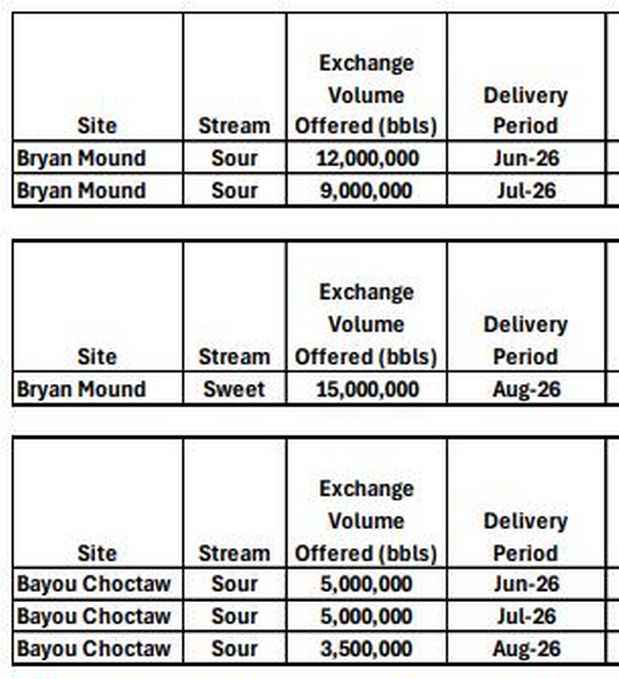
The top two tables are for Bryan Mount and Bayou Choctaw. The delivery periods are June, July and August.
Here are the last two tables on this page:
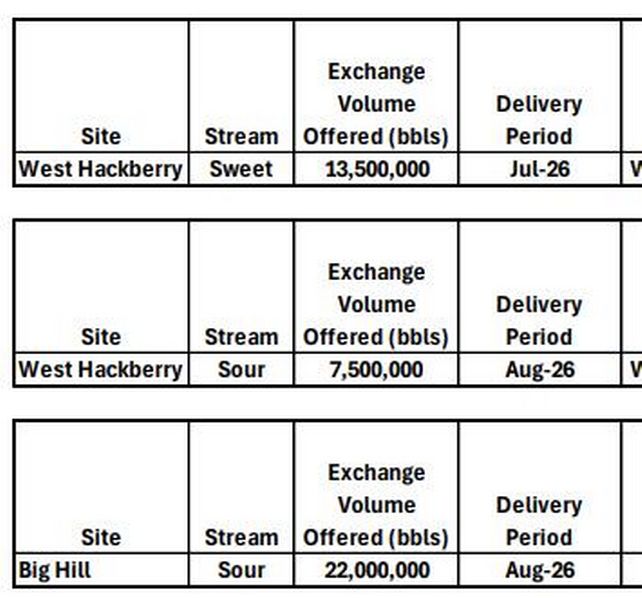
West Hackberry has deliveries in July and in August. Big Hill only has delivery of 22 MB in August. The contract specifically states in several places that delivery may be lower than stated in the table.
I am certain that the bidders were and continue to be well aware of the problems at Big Hill and did not bid on the 22 MB offered from Big Hill because they knew it would never be delivered in August 2026.
The fact that 40 million barrels were not awarded in the May 11 contract combined with the delay of Big Hill to August clearly supports my claim that Big Hill is not operational.
The June 10 SPR Contract
The June 10 Contract is even stronger evidence that Big Hill will not be available until 2027. Go to this LINK. Click on Request for proposal. It is 40 Million Barrels. Go to page 7:
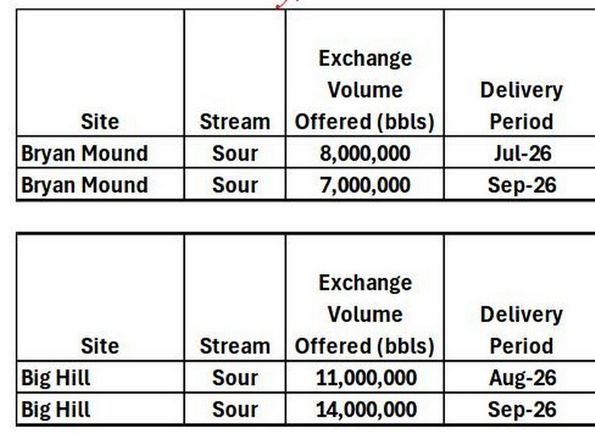
In this final contract, only a half million barrels were actually awarded out of the 40 MB offered. All of these half million barrels were from Bryan Mound, which my independent study indicated was the only one with any functional oil remaining. The other 14.5 million barrels from Bryan Mound were also not bid on because about half of the Bryan Mound caverns are also suffering from major problems.
25 million barrels were offered from Big Hill for delivery in August and September. None of this 25 million was actually awarded. In plain English, there were no Big Hill contracts awarded. It is important to ask why. The only rational answer, given the urgent need for this oil to stabilize or rig oil prices is that the oil was and still is not available.
The GOA claim that Big Hill might be operational in 2026
Given the crucial importance of Big Hill and the evidence from the contracts that it was not working – or at least that the bidders on the contracts believed it was not working and not going to be working, I spent a great deal of time investigating the actual status of the Big Hill SPR site.
When will the Big Hill SPR construction be complete?
This announced schedule as of December 2025 on the repair of the Big Hill site comes from the U.S. Government Accountability Office Report GAO-26-106918 detailing life-extension and maintenance updates across the nation's reserve sites: “Construction at the Big Hill Strategic Petroleum Reserve (SPR) site is expected to be fully complete in early 2028, though the Department of Energy (DOE) anticipates the site could be operational and construction mostly finished sometime in 2026.”
There are many reasons to doubt that Big Hill will be operational in 2026. The primary evidence that Big Hill will not be operational until 2027 is that no awards were made from Big Hill oil on any of the five contracts issued in Spring 2026. Nor have any SPR contracts been issued since Spring 2026 – despite the ongoing and still unresolved nature of the Iran War.
Trump Team Statements about Big Hill Problems
Here is what Team Trump has publicly complained the problems at the Big Hill site – both in the media and before Congress.
On June 10, 2025, Wright testified to the House Energy and Commerce Subcommittee on Energy that President Donald Trump’s efforts to replenish the SPR were hampered by more than $100 million in necessary repairs to the reserve’s facilities. The restoration, he argued, was a result of the quick drawdown of reserves following the Biden administration selling nearly 200 million barrels in 2022 and 2023 to steady global energy costs amid Russian’s invasion of Ukraine.
Wright stated that the prior administration had wasted taxpayer dollars on equipment that was purchased but left sitting on the surface, exposed to weather, rendering it unusable. This forced the current administration to invest additional funds to clear blocked access and procure replacements.
Wright also complained that SPR sites were not properly maintained, contributing to equipment failures, leaks, and deferred upgrades on the multi-billion-dollar Life Extension Phase 2 (LE2) project.
In an interview on CNBC's “Power Lunch” on Monday, April 28, 2025, Secretary of Energy Chris Wright explained that President Biden’s use of the Strategic Petroleum Reserve caused severe damage to the Strategic Petroleum ReserveReserves'caverns, which are now undergoing repairs to repair the damage: “That was such an irresponsible action to drain that reserve so quickly for electoral reasons and, in fact, it was drained so fast, it did some damage to the facilities, so right now we can only fill two of the major salt caverns we have. So we are doing repair work on two. “
My note: What Chris Wright was really saying, as we shall provide evidence below, is that in April 2025, only two of the four SPR Sites were able to accept oil without damaging the caverns at the site. One of those SPR sites that could not accept oil was Big Hill.
Several DOE funded reports also disclosed major problems at Big Hill
A June 2013 56 page report on problems at Big Hill with both the wells and the salt caverns below the wells. Below is an image of the 14 caverns at Big Hill:
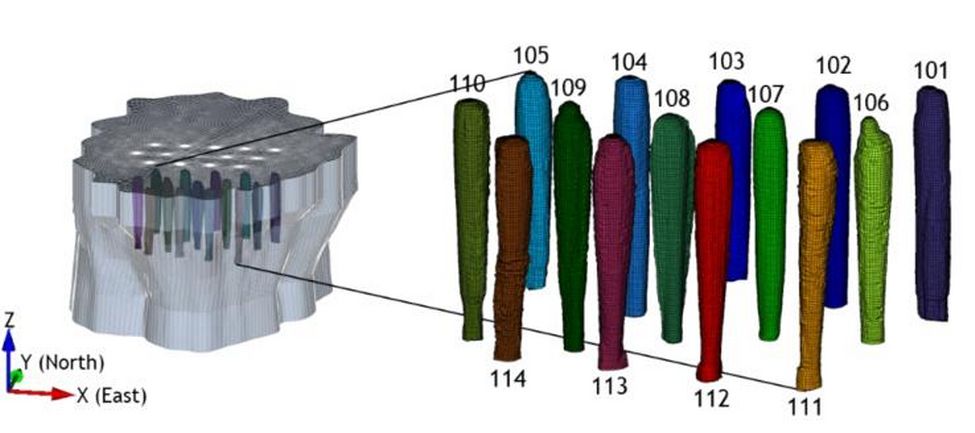
On page 43, the June 2013 report states:
“The results from this analysis indicated that the casing of BH105 and BH109 failed from shear stress that exceeded shear strength due to the horizontal movement of the top of salt relative to the caprock, and tensile stress due to the downward movement of the top of salt from the caprock. The causes of the damaged casing segments are a result of vertical and horizontal movements of the interface between the caprock and salt dome. The cavern volume closure due to salt creep produces movement between the salt top and caprock bottom. The displacement rates of the top and the bottom differ.
The magnitudes of the horizontal movements above the outermost Caverns 101, 105, 110, 111 and 114 are larger than those of the other caverns. Using the horizontal displacement of the failed well of Cavern 105 as a failure criterion applicable to the other wells predicts that the well casings of Caverns 101, 110, 111 and 114 are in jeopardy of failing by shear stress in the near future.”
“The increased distances above Caverns 107, 108, and 109 are larger than others. Using the vertical displacement of the failed well of Cavern 109 as a failure criterion applicable to the other wells predicts that the well casings of Cavern 107 and 108 may be in imminent danger of failing due to excessive vertical strain.”
The report then provided this table with predictions of when each of the Big Hill (BH) 14 caverns might start failing:
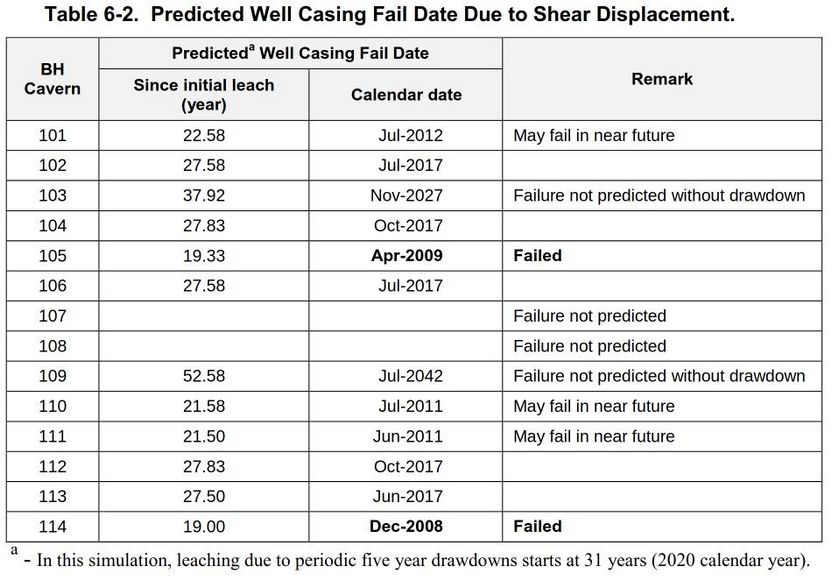
My note: In total, 6 out of the 14 caverns at Big Hill were estimated to be at risk. This estimate was based on the assumption that there would not be any drawdowns. However, the massive Biden drawdown made the likelihood of failure higher than in the 2013 report estimated. Big Hill recently experienced well integrity issues with 9 of their 28 cavern wells.
Part of the problem is that Big Hill is not stable either vertically or horizontally. Big Hill is an active dome and the salt continues to flow upward. The thick caprock has forced the salt to move laterally at the interface, evidenced by the salt overhangs, which increases stresses in the horizontal direction. These stresses play a role in well degradation. Here is an image of horizontal motion in mm per year at Big Hill from 2007 to 2022:
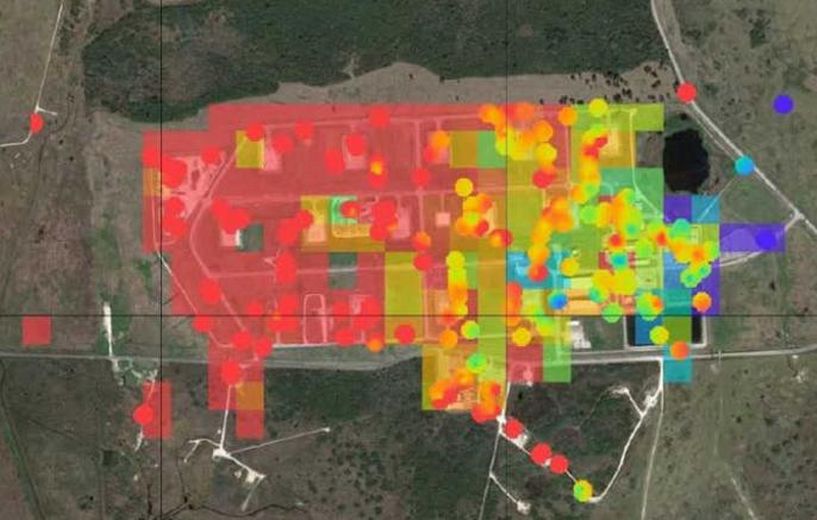
Mean displacement rate(mm/yr.)across Big Hill for 2007-2022
Red indicates an average displacement rate of more than 8 mm per year. So from 2005 to 2025, the actual displacement was 160 mm. Since 1 inch equals 25 mm, this is about 6.5 inches. The total displacement since the wells were put in could be as high as 10 inches.
Ironically, the damage to the caverns tends not to occur when the oil is removed, it occurs when new oil is put into a weakened cavern. Biden removed oil from Big Hill in 2023. Below is a table confirming that Biden drew the oil at Big Hill all the way down to 55.4 MB:
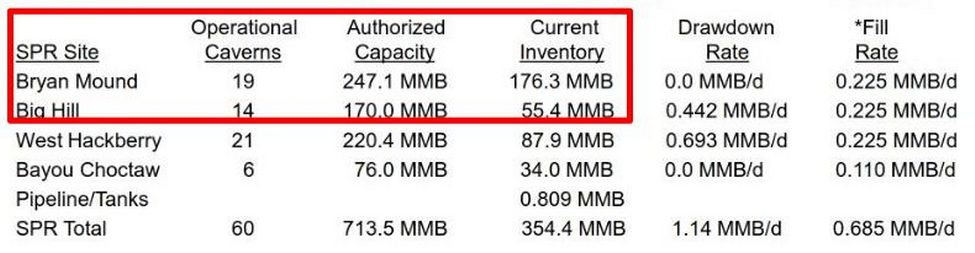
Replacement oil was put back in 2024 to bring the level back to 90MB. But this is likely when the major structural problems occurred. When oil is withdrawn from a cavern in salt using freshwater, the cavern enlarges. As a result, the pillar separating caverns in the SPR fields is reduced due to usage of the reserve. The enlarged cavern diameters and smaller pillars reduce underground stability.
Some oil experts have compared Big Hill to a “piece of junk you have in your attic”
Critics of the SPR system said the Big Hill is too creaky and expensive to properly maintain. Fred Beach, assistant director for energy policy at the University of Texas, Austin’s Energy Institute, has argued the SPR cannot be deployed fast enough to respond to real oil emergencies, whereas the private market would react instantaneously. What’s more, Beach said the pipeline rupture at Big Hill highlights the need to maintain the 1980s facility at the tune of $200 million a year. But on the other hand, he said, it’s not easy to scrap the behemoth SPR.
"It’s always hard to argue getting rid of something you already have. It’s like getting rid of that piece of junk up in your attic. Maybe Big Hill is a good example. Don’t fix, just repair it enough to drain the darn thing and decommission it."
Major Problems with SPR LE2 Project Delays
Because all four SPR sites are way past their design life, a $1.42 billion dollar project called SPR – LE2 was approved by Congress. Here is a description of this project:
“The SPR-LE2 project scope will upgrade crude oil storage, raw water, brine disposal, and oil distribution systems at the Big Hill (BH) and Bryan Mound (BM) sites in Texas, and Bayou Choctaw (BC) site in Louisiana, to ensure it can maintain readiness, meet mission requirements and operate in an environmentally responsible manner for the next 25 years.”
Here is a break down of where the money was to be spent:
* Big Hill (BH): $607M
* Bryan Mound (BM): $348M
* Bayou Choctaw (BC): $369M
The project was divided into four phases as shown below:
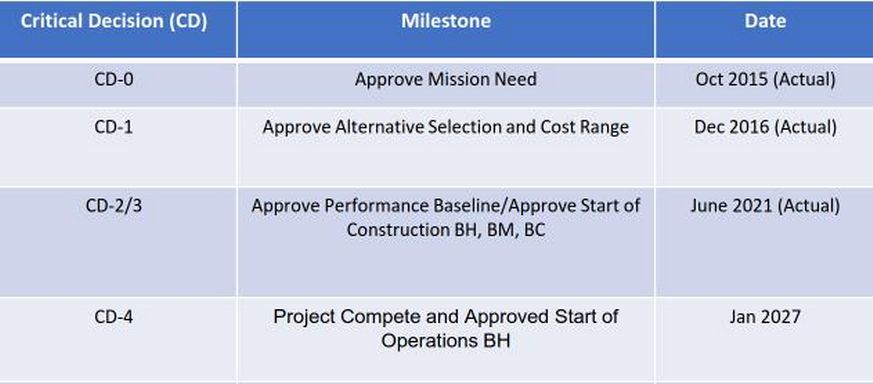
Unfortunately, Big Hill had lots of problems that delayed the start of their portion of the project by about one year. Here is a link to a July 20, 2026 article describing some of these problems.
“U.S. Strategic Petroleum Reserve (SPR) is facing serious operational challenges after years of massive drawdowns, deferred maintenance, and mismanagement. One of the four primary storage sites has been left inoperable, equipment purchased with taxpayer dollars was left exposed and unusable, and critical infrastructure repairs were neglected.”
“One site (Big Hill) was left inoperable: Reports indicate one of the four main sites was rendered inoperable or severely limited due to prior actions and lack of maintenance.”
“Wasted taxpayer dollars on equipment: Equipment was purchased but left sitting on the surface, exposed to weather, rendering it unusable. This forced the current administration to invest additional funds to clear blocked access and procure replacements.”
“Failed maintenance: Sites were not properly maintained, contributing to equipment failures, leaks, and deferred upgrades on the multi-billion-dollar site.”
“Wells are far beyond their design life, there have been multiple equipment failures (including leaks and a well rupture), and construction delays have limited site availability (e.g., Big Hill impacted by ongoing work).”
2026 Fiscal Year Congressional Justification Report provides a revised timeline – pushing Big Hill back to 2nd Quarter 2027
In January 2026 the Trump DOE submitted a 41 page budget request to Congress to finish the LE2 SPR project. This budget request explained that while Big Hill was supposed to be done by May 26, 2026, several factors will delay the completion by a total of 17 months. The budget request blames the Biden administration for the delay. Here is the text in this budget justification to Congress:
“LE2 activities were planned to occur at all four SPR storage sites: Bryan Mound (BM), Big Hill (BH), West Hackberry (WH), and Bayou Choctaw (BC); however, due to unprecedented external impacts to the program, discrete scopes have been removed. Impacts from the pandemic (supply chain disruptions, inflation, and workforce challenges) and delays related to emergency sales in 2022 have caused the LE2 activities (procurement of long lead material and construction) at West Hackberry to be suspended.”
“The emergency oil sale delayed the start of the site outage window by 12 plus months and increased the load associated with engineering and construction support. In addition, the delay from the emergency oil sales caused additional cost to be incurred by the general contractor at the Byran Mound and Big Hill sites.”
“The BCP included a new performance baseline, scope deferrals, and a new CD-4 Project Completion date of January 2027.”
“The Big Hill General Contractor continues to work with a focus on outage work since January 13, 2025, with an outage completion forecasted for May 26, 2026.”
“These cost increases are contributed to land right-of-way actions that would delay the LE2 schedule an additional 12 months (totaling 17 months), resulting in increased support costs and extended construction duration.”
“External factors have further complicated the timeline. Options under consideration include advancing the Big Hill outage schedule and deferring or descoping offsite work to mitigate schedule risk against the approved performance baseline.”
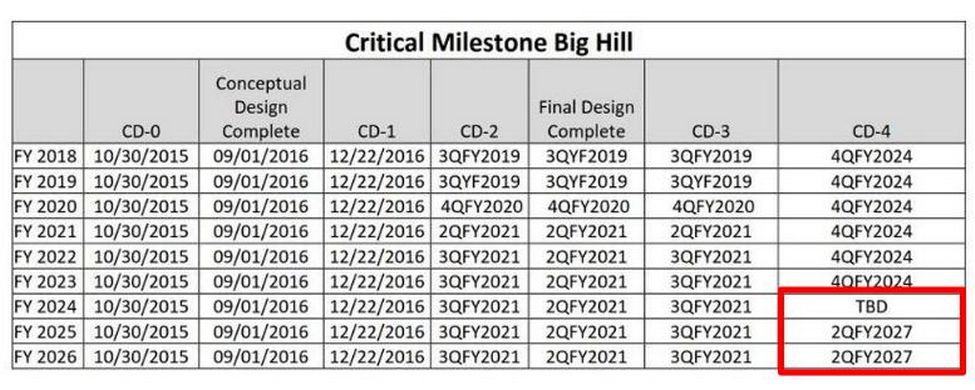
On page 7 of 41 pages, the DOE proposed a new schedule in which Big Hill, instead of being completed by May 2026, will be completed by May 2027. CD – 4 is the final phase of the LE2 Project. Here is the quote:
“New CD-4 dates for baselined sites: Bryan Mound 1tst Qtr. FY 2026, Bayou Choctaw 2nd Qtr. FY 2025, and Big Hill 2nd Qtr. FY 2027.”
Here is the table from the 2026 Budget Justification Report showing Big Hill Phase CD 4 problem started in 2024 and the new completion date has been delayed until the second quarter of 2027.
In 2025, the Trump administration fired a lot of SPR Staff
Another reason that Big Hill repair was delayed to 2027 is that there was a major cut in SPR experienced staff when Trump took over in 2025. According to the 2026 GAO report, the DOE offices that manage the SPR have lost about 25 percent of their 120 staff positions since January 2025. Staffing decreased due to early retirement incentives and buyouts. This means that the most experienced people in the SPR management were forced into early retirement and replaced with less experienced people. They were also “realigned” into a new structure called “Hydrocarbons and Geothermal Energy Office.”
Management of the Strategic Petroleum Reserve shifted toward transactional emergency exchanges and $295 million for pertroleum reserve accounts.
Here is a quote from this 17 page document: “DOE Realignment: In November 2025, DOE stood up the Hydrocarbons & Geothermal Energy Office (HGEO) and functionally realigned the Office of Petroleum Reserves (OPR), including the SPR appropriation. In the FY 2027 Budget Request, the staff and programmatic work of the SPR have been incorporated within the HGEO organizational structure.”
This restructuring may help in the future. But combined with budget cuts for 2026, it caused choas in 2026. Several articles by former SPR senior staff have criticized these changes.
On July 28, 2026, seven of these people combined to write an article called Ongoing DOE Staff Shortages Limit Trump Energy Priorities.
Here are quotes from this article: “Over the past year, the U.S. Department of Energy (DOE) has suffered massive losses of staff capacity and skills, largely due to the Trump administration’s Deferred Resignation Program, which slashed headcounts across the federal government. Occupations with skills essential to making and managing awards were among the hardest hit. As a result, many energy innovation programs ground to a halt in 2025... without an increased and targeted hiring strategy, the department risks falling short just as the demand for energy innovation is accelerating.”
“Under the Trump administration, DOE has lost over 2,700 federal staff one third were in occupations with essential skills for making and managing award programs... The massive reduction in federal staff has a compounding impact on DOE capacity due to the loss of institutional knowledge.”
“In total, the thousands of federal workers who have departed DOE under the second Trump administration took with them a combined 29,792 years of service. Nearly 90% of departing staff were career employees, over half of whom had more than five years of service, with tenure likely spanning multiple administrations. In contrast, over one third of hires over the same period were political staff, who serve limited terms and are often new to the federal workforce. “
“Mass departures under the DRP have crippled federal agencies.”
The Trump Administration also cut funding for SPR Maintenence
While the new plan called for major increases in funding in 202. The 2026 budget cut for Major Maintenence, which includes the problems at Big Hill, were more than 50%:
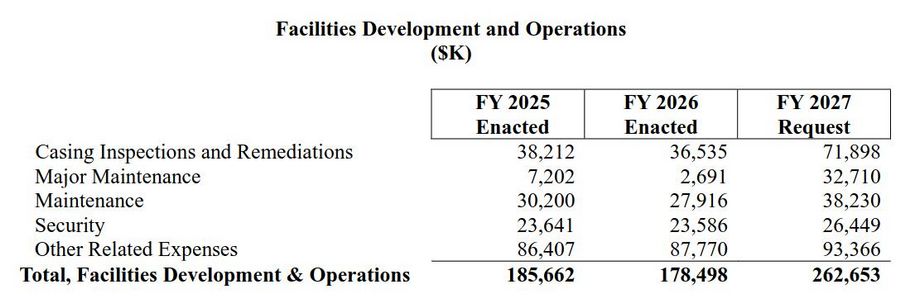
Here is a quote from page 6 of the 41 page the 2026 SPR report to Congress: “The Big Hill General Contractor continues to work with a focus on outage work since January 13, 2025, with an outage completion forecasted for May 26, 2026.”
However, another table on page 7 of 41 indicates that critical work on Big Hill that was supposed to be completed in 2024, 2025 and 2026 will not be completed until the second quarter of 2027. Big Hill is the only SPR site on the series of tables on page 7 where projects were delayed to 2027. On page 26, there is a table indicating the $65 million will be spent on construction at Big Hill in 2026.
A June 22, 2026 proposal #5 to release 40 MB from the SPR only got one bidder and that was for less than 1 MB. A July 22, 2026 article on why the 40 MB in proposal #5 did not sell stated: “DOE said the four solicitations preceding June had collectively awarded 133 million barrels across three completed exchanges.” If the starting point for the SPR was 413, this DOE statement implies that DOE thinks the end point is 280 mb – exactly the same as my 60 cavern analysis predicts to be the “most likely end point” and confirming that the SPR is likely to run out on about September 11, 2026.
The Secretary of Defense authorized an “operational minimum of 243 million barrels.” However, this minimum came from the Trump assumption that 172 MB could and would be released. In fact, the final 40 MB was not accepted by anyone in the industry making an offer. This final offer was for Big Hill oil. This leads me to conclude that Big Hill is still not fixed.
Additional Evidence that Big Hill will not be operational until 2027
If the Trump Team – and or the oil industry in general – had any confidence that the problems would be solved in 2026, the Department of Energy would have IMMEDIATELY issued a contract for this urgently needed 40 MB of SPR Oil to be “loaned” to lucky oil traders. Moreover, just to help stabilize the oil market, they would have issued the contract months in advance of the actual shipment of oil. Even if they thought that Big Hill would be fixed in November or December 2026, they would have issued the contract back in July. It is now August 21, 2026. The fact that no such contract for the 40 MB of Big Hill oil has been issued is strong and in fact irrefutable evidence that the Department of Energy and in fact the entire oil industry is fully aware that Big Hill will be offline until 2027. It is not merely that Big Hill was non-functional in December 2025. It is that it is still non-functional on August 21, 2026. This indicates that there is a major problem at Big Hill – not some minor temporary maintenance problem.
Why the absence of Big Hill matters
In our prior reports, we have used three independent methods all of which led to the conclusion that Tank Bottom for the SPR is about 280 MB. The absence of 170 MB in capacity from the Big Hill SPR was a major factor in all three of our methods. The absence of the Big Hill SPR explains why only 133 MB of oil from the SPR was awarded in Spring 2026 and why there have been no futher SPR contracts awarded since Spring 2026. Because 11 MB was withdrawn in the past two weeks, there are only 12 million barrels left to be distributed from the Spring SPR contracts. Put in plain English, there are only 3 to 4 weeks left until SPR Doomsday.
Why SPR Doomsday Matters
We have provided a great deal of evidence that the SPR was “given away” in a manner that it will never be paid back. This created a “gambling casino” in which certain “Lucky Corporations” use 13 million “thousand barrel SPR oil contracts” to rig and manipulate and artificially lower the price of oil. Once these millions of “thousand barrel SPR oil contracts” are no longer being given away, the Lucky Oil Traders will no longer be able to rig, manipulate and artificially lower the price of oil. The price of a barrel of oil will then start rising to its real price.
How high will the price of a barrel of oil go?
There is an ETF traded fund that mimics what oil tankers pay for oil. It is called the Breakwave Tanker Shipping ETF (NYSE:BWET). In early February, the price of a barrel of oil on that ETF was $67. As of August 14, 2026, that same barrel of oil is $379.
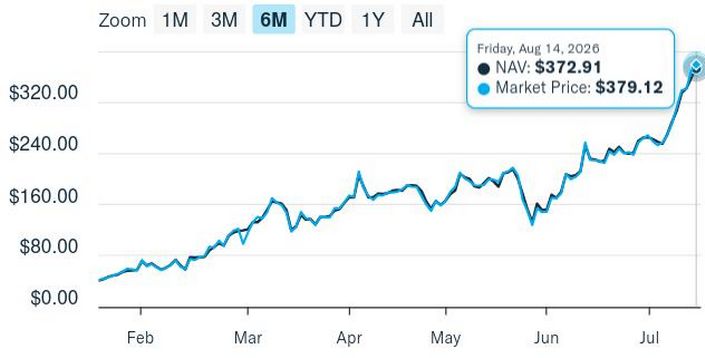
Elsewhere in this report, we provided other estimates of the true market price for oil – which indicated it was between $150 to $200 per barrel.
The clock is ticking… there are only 2 to 3 weeks left
We have now shown why Big Hill is not operational and provided a mountain of evidence that Big Hill will not be operational again until the second quarter of 2027. The clock is ticking… there are only 2 to 3 weeks left until SPR Doomsday.
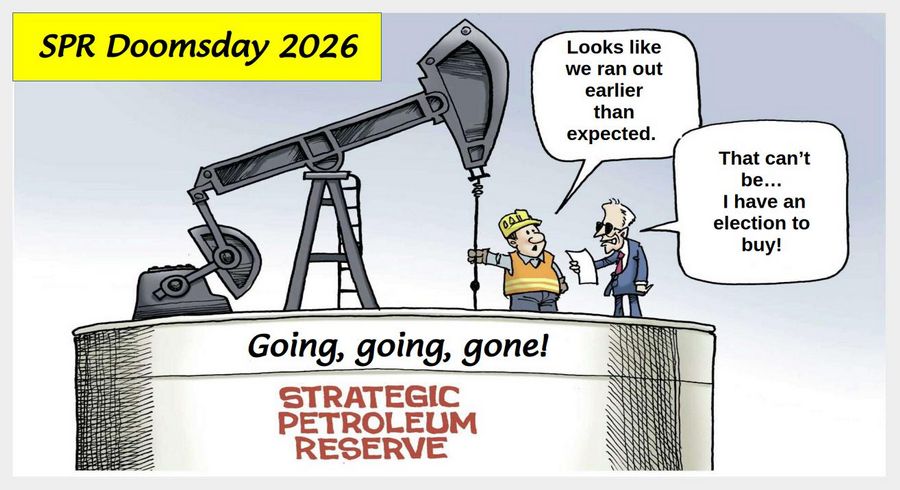
We now have a way to calculate SPR Doomsday in real time. Now that we have gotten past some of the SPR and MOU lies, we are ready to expose the greatest robbery in human history. We are all riding on the Titanic and so far, we have just exposed the tip of the iceberg. The next section begins the real exposure of Mega Corruption that is certain to sink the American economy.