VII The First Casualty of War is the Truth
"In times of universal deceit—telling the truth is a revolutionary act."
George Orwell
It has been claimed that the phrase “The First Casualty of War is the Truth” comes from an ancient Greek proverb dating to 500 BC. Certainly, the first casualty of the Iran War was the Truth.
The truth is that Iran is never going to agree to surrender to the US demands. To better understand why this is true, we will take a closer look at the June 2026 Memorandum of Understanding and the subsequent and historic burial ceremony for Iran’s martried religious leader. We will then conclude this chapter with an honest look at what has happened during the last few weeks of the war.
Why negotiations and the June MOU have no real effect on the price of oil and had no real chance of being honored
On April 8, 2026, Trump announced that he had agreed to a two-week ceasefire. The negotiations in Pakistan began on April 11, 2026. It would be easy to claim that the huge drops in the price of oil during the weeks of April 10 and April 17 were due to this ceasefire and or negotiation. There are three major problems with this claim. The first is that there was no change in the actual availability of oil. The Strait of Hormuz was still almost completely closed:
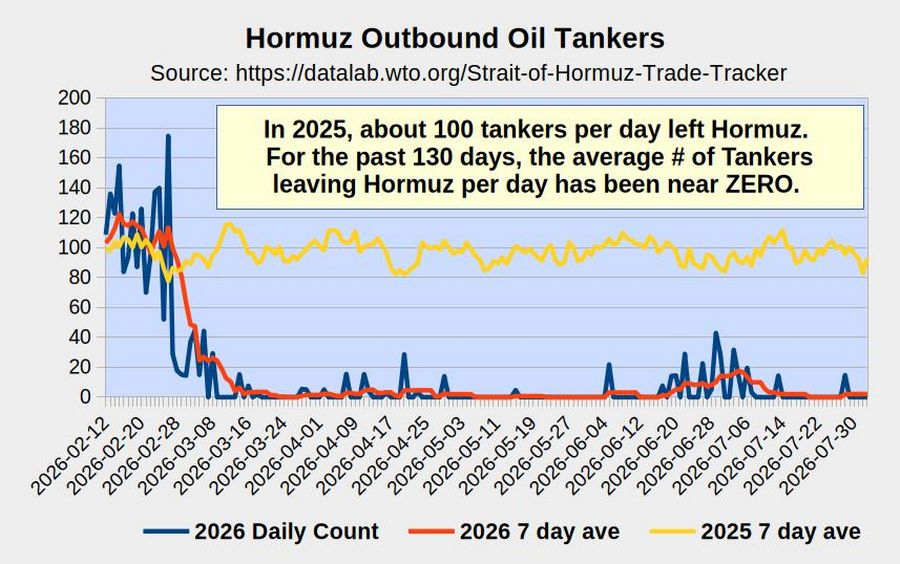
The second problem is even more important. Even if the Persian Gulf miraculously opened, it would take (and will take) MONTHS for the supply of oil to recover on the world market. We will shortly show that the actual reason for these price drops was extreme oil market rigging. The price was dropped deliberately in order to fool Americans into believing that there would be an end to the war even though there was no chance for the war to end.
Which brings us to the third problem. The June MOU itself was a fake document intended to fool Americans into believing that the Iran War was about to end. The War Machine never had any intentions of complying with the 14 points. They were and are making way to much money on the war to allow that to happen. Even Iran was well aware that the US would not comply. Both sides essentially used to the two week end of June ceasefire to re-arm and prepare for more war.
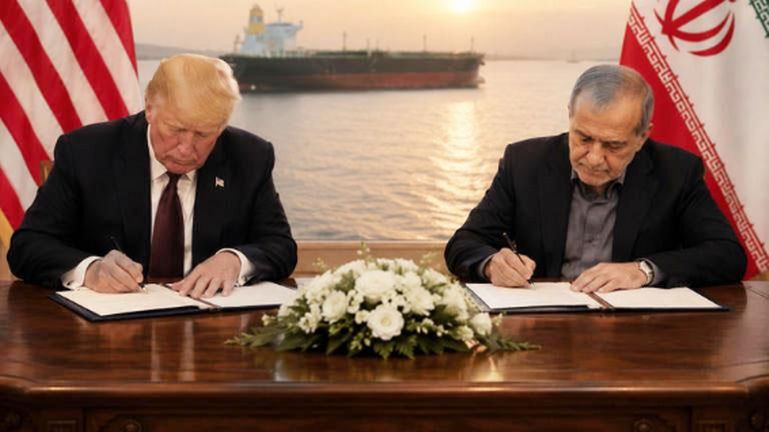
On June 17, 2026, Iranian President Masoud Pezeshkian signed the fake MOU remotely from Iran and President Donald Trump signed the fake Memorandum of Understanding at the Palace of Versailles in France. This MOU suffered the same fate as the previous Treaty of Versailles.
It appears that the official version of this MOU was never published in the US. All that was released was a heavily edited version. However, the actual text of the 3 page 14 point MOU was published by Iran and can be read at this LINK.
It is understandable that the public might be fooled by corporate media lies about how the MOU would bring “peace in our time.” But oil traders are not so easily fooled. All one has to do is take a few minutes to read the 14 points to see that it amounts to a US surrender – of a magnitude even greater than the German surrender in the first Versailles Treaty.
Here we will look at the actual words of just a few of the 14 points and why the War Machine is not likely to ever comply with any of them.
Point 1: The United States of America and the Islamic Republic of Iran and their allies in the current war by signing this MoU, declare the immediate and permanent termination of military operations on all fronts, including in Lebanon, and undertake from now on not to initiate any war or any military operation against each other, and to refrain from the threat or use of force against each other, and ensuring the territorial integrity and sovereignty of Lebanon. Final deal will confirm the permanent termination of the war on all fronts, including in Lebanon, and other provisions of this paragraph.
Iran insisted that Israel must leave Lebanon. Israel made it clear that they will not leave Lebanon. So we could stop our analysis right here. But let’s go on to see how ridiculous this document was:
Point 5: Upon the signing of this MoU, the Islamic Republic of Iran will make arrangements using its best efforts for the safe passage of commercial vessels with no charge for 60 days only from the Persian Gulf to the Sea of Oman and vice versa. The traffic of commercial vessels will immediately start, and considering the need for removing the technical and military obstacles and demining by the Islamic Republic of Iran, will be instated within 30 days. The Islamic Republic of Iran will conduct dialogue with the Sultanate of Oman to define the future administration and maritime services in the Strait of Hormuz in discussion with other Persian Gulf littoral states in line with the applicable international law and the sovereign rights of coastal states of the Strait of Hormuz.
Point 5 is remarkable in that Iran is given total control of the Strait of Hormuz. Nowhere in point 5 is the US even mentioned.
Point 6: The United States of America undertakes with regional partners to develop a definitive, mutually agreed plan with at least $300 billion for the reconstruction and economic development of the Islamic Republic of Iran. The mechanism for the implementation of this plan will be finalized as part of a final deal within 60 days. All required licenses, waivers and permissions needed for the relevant financial transactions will be granted by the United States of America.
This is the $300 Billion War Reparations clause to be paid by the US and its regional partners (such as Saudi Arabia). Can you imagine anyone in Congress voting to authorize paying $300 billion to Iran? Niether can I. Another reason the war will go on.
Point 10: The United States of America undertakes that immediately upon the signing of this MoU until the termination of sanctions, the US Department of Treasury will issue waivers for the export of Iranian crude oil, petroleum products and derivatives, and all associated services, including banking transactions, insurances, transportation.
Point 11: The United States of America undertakes to make fully available for use the frozen or restricted funds and assets of the Islamic Republic of Iran upon the implementation of this MoU. The United States of America and the Islamic Republic of Iran will mutually agree on the procedures related to the release of these funds during the negotiations. Such funds, either retained in the original account or transferred, shall be made fully usable for payment to any ultimate beneficiary designated by the Central Bank of the Islamic Republic of Iran. The United States of America undertakes to issue all necessary licenses and authorizations accordingly.
The total amount of Iran restricted or frozen funds is about $100 billion dollars. The funds originated primarily from oil and gas exports to third countries that were blocked by U.S. secondary sanctions that deterred international banks from processing payments. These funds were supposed to be released and returned to Iran immediately on signing the MOU. But even after two weeks, and several promises that the money was coming, not a single frozen dollar was ever released.
Point 13: After signing this MoU and subject to the beginning of the implementation of Paragraphs 1, 4, 5, 10 and 11 of this MoU and the continuing implementation of these measures, the United States of America and the Islamic Republic of Iran will start negotiations regarding the final deal exclusively on the other paragraphs.
Points 1 and 5 are extremely unlikely to ever be carried out. Points 10, 11 and 13 require the immediate lifting of sanctions against Iran and the return of $100 billion dollars in frozen Iranian assets. This was supposed to happen immediately. It never happened – confirming conclusively that the entire MOU was a fake document intended solely to deceive the American people.
The largest gathering in human history
During the first two weeks of July 2026, 43 million Iranians made it clear during the funeral marches for their assassinated religious leader that they do not want their new leaders to negotiate with the US killers of their fallen leader about anything. They all wore black clothes and chanting “Death to America.” Millions of them carried red flags. The red flag in Shia Islam stands for “Blood for Blood” revenge.
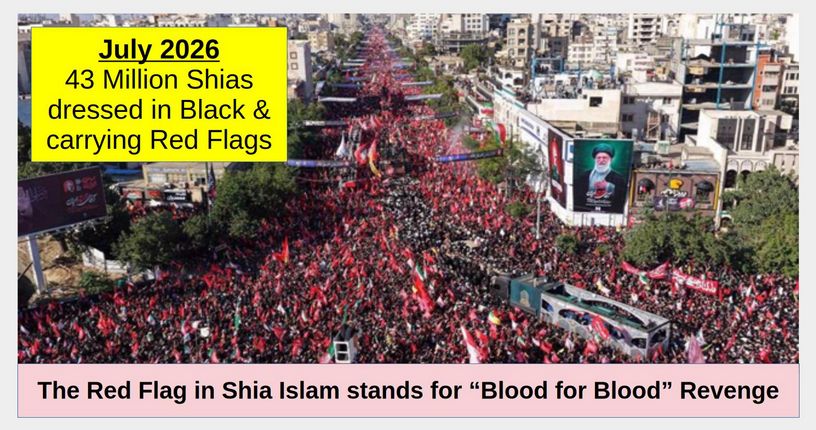
In a message issued following the funeral ceremonies for their martyred Leader, Ayatollah Seyyed Ali Khamenei, the new Leader (his son) praised the massive public participation in Iran and Iraq, calling it an extraordinary display of support. “We pledge to avenge the pure blood of the martyred Leader and all the martyrs of these two wars from the criminal and disgraced murderers.”
The new Ayatollah declared that avenging the blood of the martyred Leader (his father) and all the martyrs of these two US-Israeli wars of aggression against Iran was “the demand of our nation and must certainly be carried out.”
On July 9, 2026, a leader of the Iranian navy warned that “foreigners have no place in this land and the Strait of Hormuz”, adding: “any adventurism by the terrorist U.S. military and any interference in determining the routes of maritime traffic will not only be met with our decisive response, but will also seriously disrupt the gradual reopening process and put the interests of countries using the Strait of Hormuz at serious risks”.
On July 12, 2026, the leader of Iran’s Revolutionary Guard, stated "We will not allow a rogue and child-killing army from the other side of the world to continue its illegal interference with the Strait of Hormuz”.
On July 13, 2026, Iran Minister of Foreign Affairs Baghaei held a Press Conference where he stated:
“This war truly reaches the height of insolence for those whose hands are stained with the blood of innocents. Those who are responsible for the martyrdom and murder of thousands of our compatriots… Lying has become part of the behavior pattern of the American ruling class…The southern part of the Strait of Hormuz was misused to harm Iran's security and national interests… We cannot allow America and the Zionist regime to use this strait for Traffic that is harmful to Iran's national sovereignty and national security… This is the reason It was insisted that in paragraph 5 of the memorandum of understanding that future management of the Strait will be by Iran in consultation with Oman… We will not allow the Strait of Hormuz to become a place of security threat. The important point is that the Iranian people have a very bitter experience of America's breach of treaty. For us, diplomacy is a tool, and I think that in this regard, the Iranian people still support their decision-makers.”
“Wherever diplomacy serves Iran's national interests, everyone will support it with one voice. Regarding negotiation, it is natural that opinions differ, but on the main issue, there is complete consensus. We will use any means necessary to ensure our national security.”
Also on July 13, 2026, Iranian Foreign Minister Araghchi held a Press Conference in which he stated:
“Iran reserves all options to defend its security and its people… Attacking a nuclear power station is an unforgivable violation of international law… We were in diplomacy, but we were attacked militarily (by the US) and they only understand the language of threats and force… There is no red line that they have not crossed and the most dangerous one happened last night when our nuclear power station was bombed by the Americans. Our people are united and we stand firm against any aggression.”
“President Trump was elected on a platform of putting an end to America’s costly involvement in Forever Wars. He has betrayed not only Iran by abusing our commitment to diplomacy but also betrayed those who voted for him in the last American election. “
On July 14, 2026, the Iranian Parliament voted 400 to 0 to end the Memorandum of Understanding. They stated that Iran will not enter into any further negotiations with the United States. Since then, Iranian leaders have stated there will be no negotiations until the US shows Good Faith by complying with the terms of the MOU.
US losses from Iranian retaliation strikes in July 2026.
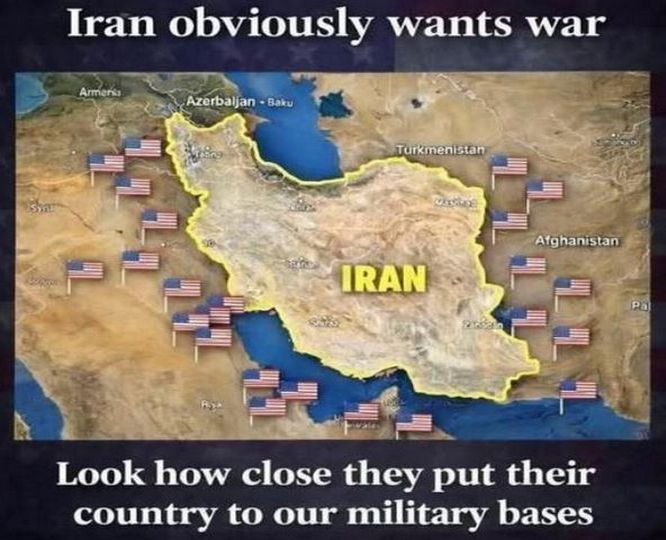
Iran has now destroyed most of these US Bases.