
III Why Putting Oil in Salt Caverns is a Very Bad Idea
In this report, we provide a mountain of evidence that the US Strategic Petroleum Reserve, aka SPR, is on the verge of being completely dead. It will stop working around the point that it reachs 282 million barrels of oil. The 60 Salt Caverns – located at four SPR Sites near the Gulf Cost - that hold this oil will still have 282 million barrels of oil. But this remaining oil will no longer be accessible for a variety of reasons. In the section, we will review some of these reasons and explain why this oil should have been stored in steel oil storage tanks instead of being placed in unreliable salt caverns.
We will begin with some images and diagrams of what the Salt Caverns look like:
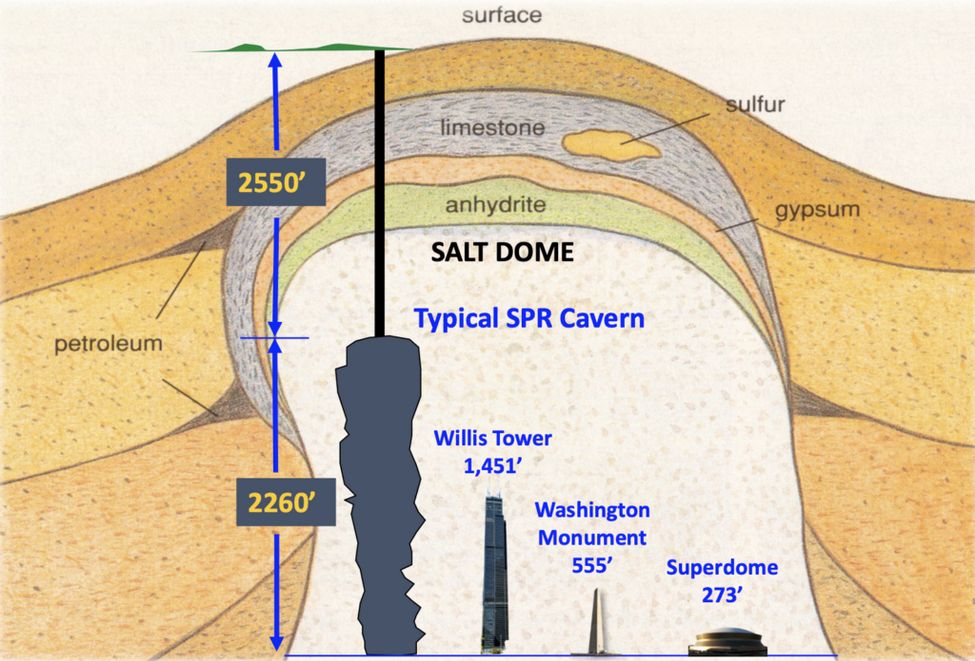
Salt caverns are located in salt domes that are hundreds to more than one thousand feet below ground. There are 10 to 20 salt caverns created in each salt dome. Each cavern is about 200 feet wide and 2000 feet high. There is a huge problem is that portions of the salt cavern can move both vertically and horizontally relative to the hard rock roof above it. This motion creates shear stress fractures in steel well casings leading to erosion and failure of the wells.
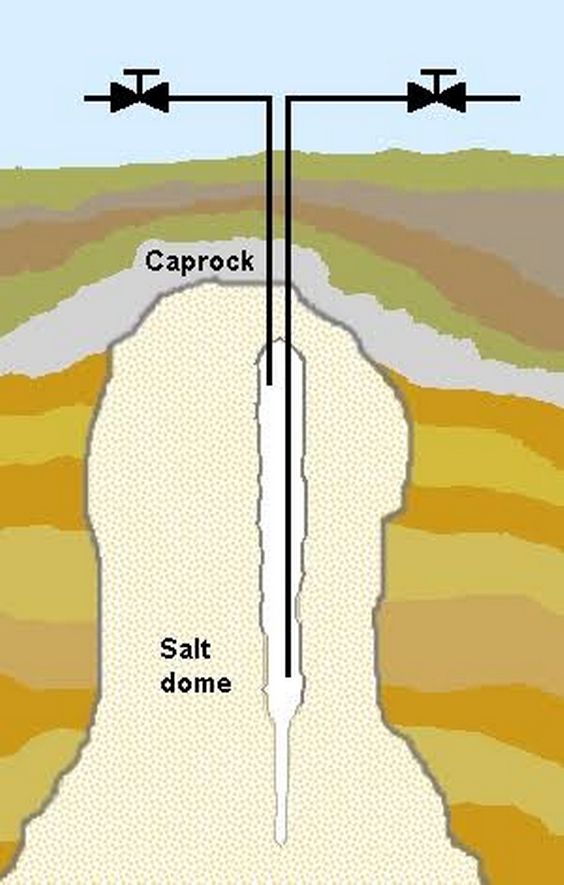
Each cavern has two wells. The first well is for pumping fresh water into the bottom of the cavern. The second well is for pumping oil out of the top of the cavern. The problem with pumping fresh water into the salt cavern is that each time water is added to the bottom of the cavern, it dissolves a lot of the salt creating a widening at the bottom of the cavern. This widening can cause the side walls of the cavern to collapse. It also reduces the width of the salt pillars between the caverns.
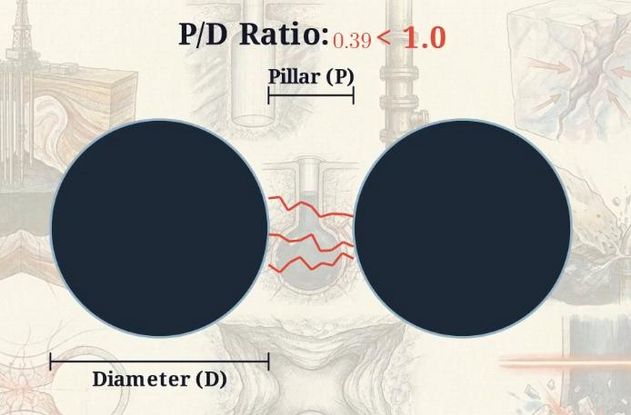
Several caverns have dropped below the Pillar to Cavern Diameter Ratio which should be one or greater. In plain English, the pillars between many caverns are only 80 feet wide when they should be 200 feet wide. Below is a sonar image of Bryan Mound cavern 116.
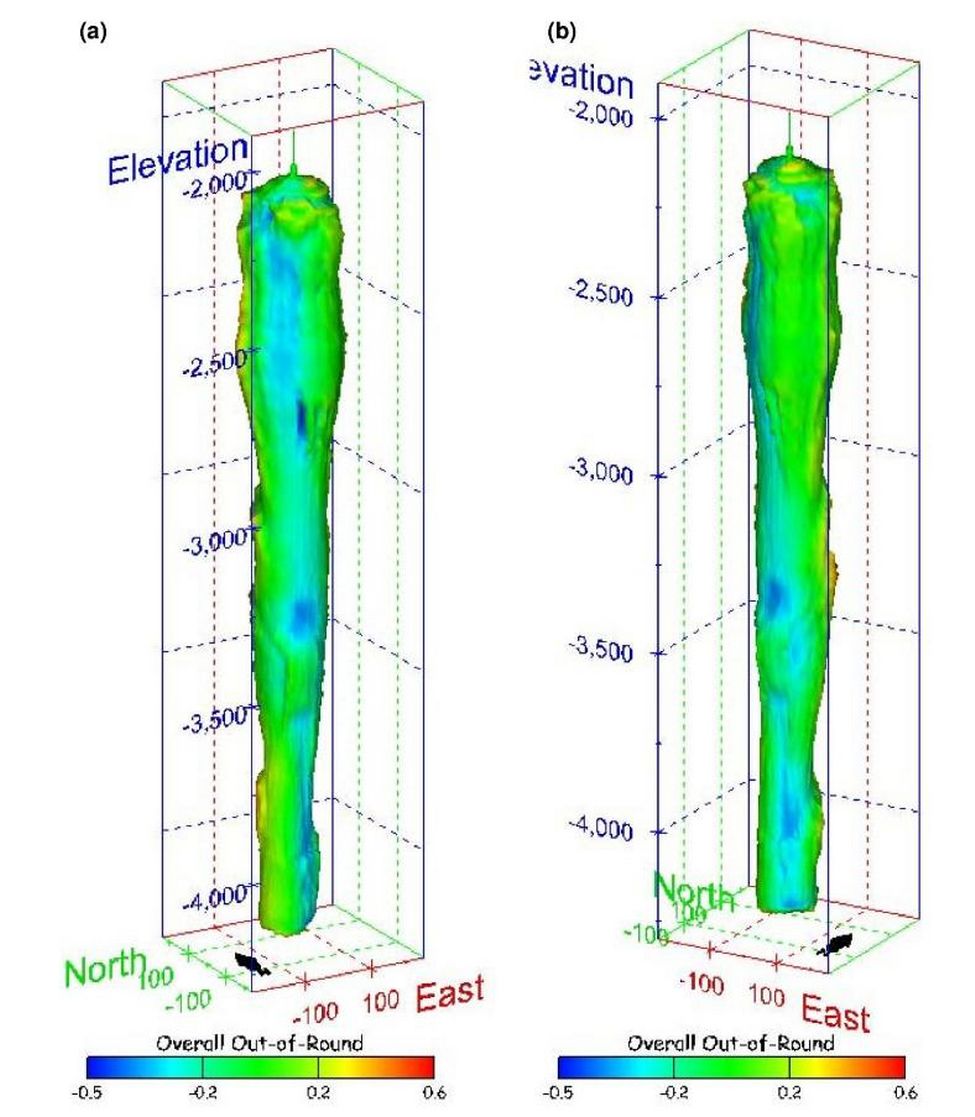
Note that over time, caverns get deformed shapes due to the varying density of the salt.
Here is an diagram of the water and oil pumping systems (which ignores the hundreds of feet of hard rock above the salt cavern but shows the varying density of the salt in the walls of the cavern).
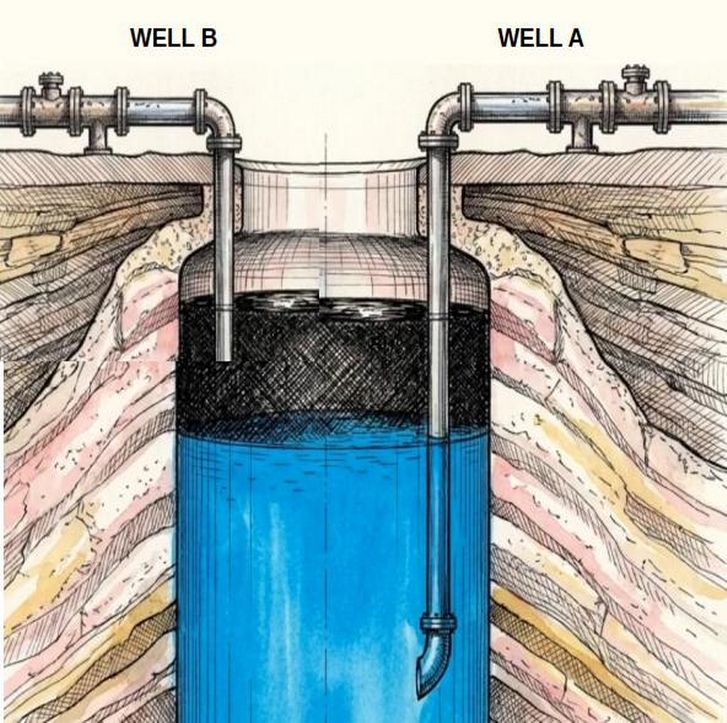
These pumping systems also suffer from corrosion and break down over a period of years due to the high pressures involved in pumping the fresh water into the bottom of the salt cavern and the extraction of the oil from the top of the salt cavern. Now that we have a basic understanding of what these salt caverns look like, let’s review some of the major problems.
Eight Major Problems of Storing Oil in Salt Caverns
Salt caverns suffer from several major problems. These include:
#1 The Salt Domes holding the salt caverns are unstable. The salt caverns in the salt domes move both vertically and horizontally over time. Many caverns have moved more than one foot horizontally and more than 10 feet vertically. This “salt creep” causes cavern instability and well casings connecting the caverns to the surface to break.
#2 The Salt in the Salt Domes have a wide variety of Densities. This causes caverns to develop voids and alters the shape of the cavern making the behavior of each cavern unpredictable over time.
#3 The Salt in each cavern mixes with water which expands the width of the cavern and creates unpredictable voids over time. Each time oil is removed from a cavern, water is injected in the bottom of the cavern to force oil out of the top of the cavern. The injection causes about 15 barrels of salt to be dissolved for every 100 barrels of oil removed from a cavern. The water dissolves the salt in unpredictable ways such that after a few cycles, the cavern is oddly shaped and no longer stable.
#4 As the width of each salt cavern expands, the width of the walls between the caverns gets smaller affecting the stability of nearby caverns. Nearly all of the caverns are very close to other caverns so that the walls between them become thinner each time oil is removed from them. The caverns were designed to last for 25 years and only have 5 drawdowns. Instead, there has been more than 20 drawdowns over a 40 year life span.
#5 The wells connecting the salt caverns to the surface can not handle the motion of the salt domes and break down over time. There is a huge amount of shear stress put on the wells connecting the caverns to the surface by both the vertical and horizontal motion of the caverns because the “rock cap” above each cavern does not move and tries to hold the metal well shaft in place. The steel well casings bend and break at the intersection of the rock cap to the top of the cavern. Once fractured, corrosion quickly damages the steel casings. Well casing corrosion is further accelerated by the high temperatures and high chloride concentrations in the salt caverns.
#6 The heaviest oil sinks to the bottom of the cavern and mixes with water and salt to form sludgy brine. This brine can clog the wells as high-salinity brine drops solid particulates and causes corrosion, dropping well rates to 50% or less of their original design capacities – making it challenging to pump brine out of the cavern and out to sea. This sludgy brine increased “back pressure” on the entire pipe system, taxes well pumps causing them to fail, breaks valves and wears out the surface piping networks.
#7 Repeated small drawdowns widen the shape at the bottom of caverns causing the sidewalls above the wide areas to collapse and harm the well casings near the bottom of the cavern. Here is a quote from a 2014 study about the Big Hill SPR site problems: “These falls often damage hanging steel tubulars, which are expensive and time consuming to replace… There is also evidence that both the well casing and hanging string problems at the Big Hill site should be addressed in several of the caverns, but due to budget constraints, there is no plan for restoring or replacing the suspect caverns.”
#8 The above problems make it is impossible to tell what the actual amount of “functional oil” remaining in any given cavern actually is or when any given cavern will suddenly stop working. About $1.4 billion dollars has been spent trying to fix the SPR during the past 6 years. We contend this is a waste of money. There is no way to fix a system that is inherently unstable and unreliable.
Initial SPR Construction Corruption and Price Increases
From the very beginning, the SPR was plagued by problems that doubled and redoubled the initial cost of the project. Here is a quote from one account of these problems.
“Due to political pressure to get oil stored as soon as possible, the construction schedule was compressed and started in 1977. But the project was soon mired in setbacks. The Federal Energy Administration employees tasked with overseeing the project had little experience in managing large construction projects, and cost control proved difficult. Material and equipment specifications were created before plans were fully complete, creating problems when the selections later proved to be unsuitable. Equipment such as pumps were chosen because of availability, not because it was best suited for the job, resulting in breakdowns and costly workarounds.
Contractors taking advantage of management inexperience engaged in “extensive fraud”; used valves were sold as new, and drill bits were purchased, stolen, and then re-sold back to the government. One contractor was indicted for stealing 18 truckloads of equipment worth $427,000.
Of particular concern is whether gunk oil illegally put in the salt caverns could gum up the pipes and make it difficult to retrieve crude oil during a national emergency. For example, one contractor was accused of making off with $8 million worth of petroleum bound for Bayou Choctaw and pumping in “hazardous and toxic wastes” instead (though the government denied that this occurred). By the late 1970s, over two dozen SPR fraud cases were being investigated simultaneously.”
“Collectively, the technical, political, and managerial challenges encountered when building the SPR drove up costs and pushed back delivery dates. In 1976, the estimated cost of the SPR through Phase II was $766 million; just two years later that had risen to $1.47 billion (~$7.5 billion in 2026 dollars). The original plan called for Phase III to be complete by 1983, with 750 million barrels of crude in the ground. But the actual fill level in 1983 was roughly half that, with many caverns yet to be completed. Between 1980 and 1993, 49 new solution-mined caverns for the SPR were created, bringing its total storage capacity up to 750 million barrels, but the actual fill level would remain at just over 500 million barrels into the 2000s.”
“The SPR has a huge maintenance backlog and has been described as being held together with “band aids.” A planned large-scale SPR renovation and maintenance program, Life Extension Phase 2, began in 2021 but was scaled back due to high costs.”
The Weeks Island SPR Site Example
In the 1990’s, the Department of Energy was forced to remove 73 million barrels of oil from the Weeks Island Strategic Petroleum Reserve in Louisiana. Ground shifts and sinkholes created fractures in the salt dome, letting fresh water leak inside and risking a major structural collapse. In 1994, the decision was made to decommission the site, and by 1999, the majority of the oil had been transferred to other SPR facilities, at a total cost of almost $100 million.
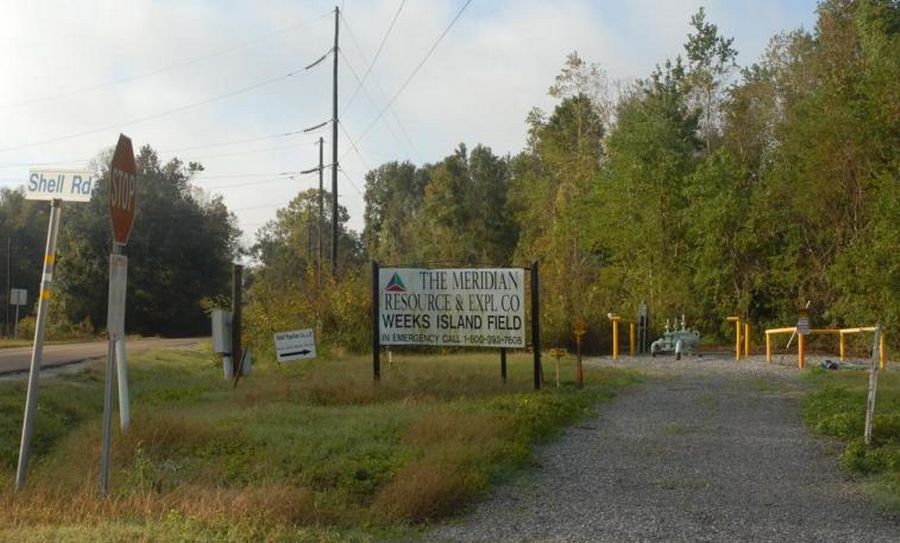
These activities required about six years of intense operational, engineering, geotechnical, and management support efforts, following initiation of site abandonment plans in 1994.
The Weeks Island SPR mine stored about 72.5 million barrels of crude oil, until November 1995, when the DOE initiated oil drawdown procedures, with brine refill and oil skimming, and numerous plugging and sealing activities.
The underground decommissioning processes were greatly complicated by the existence of brine in the mine and the major concern that the water leak from the sinkhole might become uncontrolled before all the oil could be systematically removed.
The primary brine leak into the mine was isolated from the aquifer by construction and multi-year maintenance of a 60-ft diameter freezewall around the main Sinkhole. There were several delays resulting from complications in handling of the oil during drawdown and skimming, and associated brine filling activities.
The nonrecovered quantity of oil abandoned in the mine, about 1 and a half million barrels of oil was assessed to be stably trapped, predominantly, in the significant quantities of loose salt remaining in the mine; and floating on the brine fill and trapped in many small roof irregularities.
Siddharth Misra, a petroleum engineering professor at Texas A&M University, has estimated a practical operating range of 250-300 million barrels, which cavern integrity and operational capability face elevated risks, according to ENERGY, as quoted in CNBC. Misra stated: “When the inventory drops below 300 million barrels, the SPR loses its ability to pump oil at rapid speeds to address emergencies, Misra said. The system's pipes and pumps could also get damaged as the oil layer thins at the top and sludge rises toward the extraction intake at the cavern ceiling… Fresh water is pumped into the caverns during drawdowns, which dissolves the salt walls. This creates flatter, less stable roof and severely thins the critical salt pillars that separate adjacent caverns, greatly increasing the geological risk of a structural cave-in… Because the system was not designed for this many cycles, the repeated injection of water and extraction of oil have caused severe cavern deformation, accelerated the rate of massive salt falls from the ceilings, and significantly weakened the overall structural integrity of the aging reserve.”
Some oil experts have compared the Big Hill SPR Site to a “piece of junk you have in your attic”
Critics of the SPR system said the Big Hill is too creaky and expensive to properly maintain. Fred Beach, assistant director for energy policy at the University of Texas, Austin’s Energy Institute, has argued the SPR cannot be deployed fast enough to respond to real oil emergencies, whereas the private market would react instantaneously.
What’s more, Beach said the pipeline rupture at Big Hill highlights the need to maintain the 1980s facility at the tune of $200 million a year. But on the other hand, he said, it’s not easy to scrap the behemoth SPR.
"It’s always hard to argue getting rid of something you already have. It’s like getting rid of that piece of junk up in your attic. Maybe Big Hill is a good example. Don’t fix, just repair it enough to drain the darn thing and decommission it."
If salt caverns are so unreliable, why did our government decide to use salt mines to store our most important strategic reserve oil in them?
The answer is that US politicians suffer from extremely short sighted thinking. Salt caverns are cheaper that steel oil storage tanks. According to a 1973 report, the initial construction cost of providing emergency petroleum storage for 500 million barrels of oil by steel tanks would be about $1.7 billion and $2.8 billion. The construction cost of providing emergency storage by means of salt dome storage was $567 million for 540 million barrels of oil. Put another way, steel tanks would cost about $3 per barrel while storage in salt dome cavities would have an initial construction cost of about $0.70 per barrel. The cost estimated for salt dome storage were based on a plentiful and inexpensive supply of fresh water to leach the cavities and on the offshore disposal of the brine. About 10 barrels of fresh water are required to leach 1 barrel of oil storage. As a result, storage costs can be substantially affected by the availability and cost of large volumes of fresh water.
If the fresh water costs are increased by a factor of 10, the per barrel storage costs would be increased to about $1. Thus including the transfer and disposal costs brings the initial cost of the salt dome to $1 per barrel versus $3 per barrel for steel tanks.
A 1974 report increased the cost difference between steel and salt storage. The steel tanks were raised to $4 a barrel making the initial cost of steel tanks for 500 million barrels of oil about $2 billion versus about $500 million for the initial cost of storing oil in salt caverns.
What the 1973 and 1974 reports failed to consider was the long term savings of steel tanks compared to salt caverns. Maintenence costs of salt caverns are much higher than steel tanks. We are currently spending more than $100 million a year trying to keep the salt caverns from collapsing. We are also spending $1.4 billion during the past 4 years in a failed attempt to prolong the life of the SPR salt caverns. But the biggest cost of the salt caverns is that we may not be able to get out more than a tiny fraction of the nearly 300 million barrels of oil remaining in them – which could cost us nearly $30 billion.
In addition, well maintained steel oil tanks can last up to 100 years which is three times longer than the salt caverns. For security reasons, the steel tanks can be spread out across the US rather than keeping all of our SPR oil in four sites all on the Gult Coast. But most important, we would actually know exactly how much oil is in metal tanks compared to being caught off guard by the failure of salt mines.
Why 540 million barrels was chosen for the initial SPR capacity
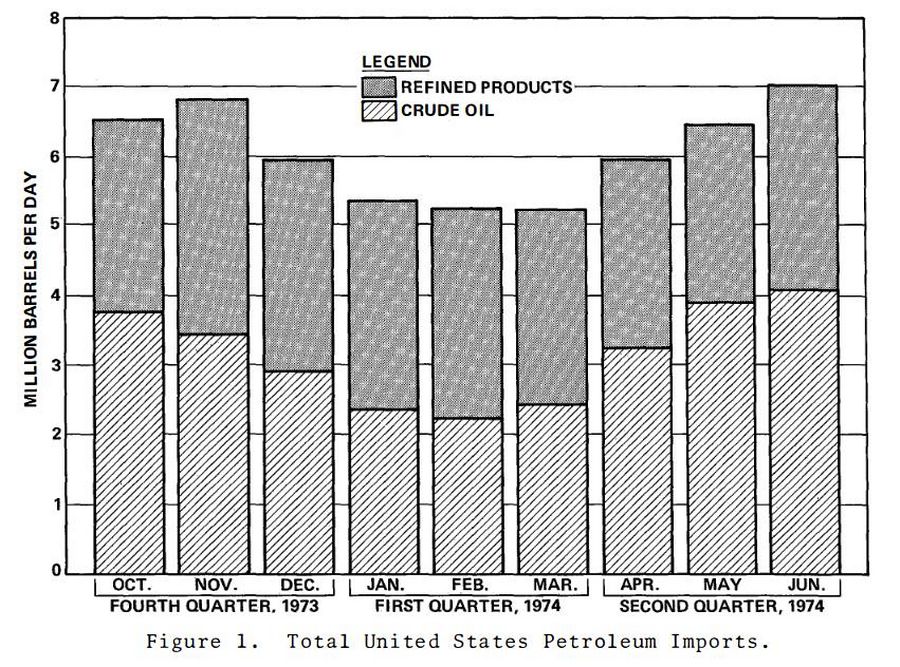
The 1974 report chose 540 million barrels as the minimum needed to protect the US economy from a repeat of the 1973 OPEC Oil Embargo. On October 16, 1973, Kuwait, Iran, Iraq, Qatar, Saudi Arabia, and the United Arab Emirates (OPEC) raised oil prices from $2.90 to $5.11 per barrel. They raised their prices to $11.65 per barrel in December 1973 - a quadrupling of oil prices since October. From mid-October 1973 to mid-March 1974, the US experieneced an embargo on oil from these Arab exporting countries. It took 2 months for the shortage to reach the US. Imports fell 2 million barrels per day from 7 MB to 5 MB per day.
The 1973 to 1974 oil embargo caused huge gas shortages in the US, raising inflation to over 12% and pushed unemployment above 9% with a half million Americans losing their jobs. It also led to the 1974 stock market crash and reduced the US GDP by $20 billion dollars.
The 1974 study assumed a “worst-case” repeat of this embargo would be a reduction of 3 million barrels per day and that the embargo might last as long as 6 months or 180 days. Multiple 3 times 180 days and the result is 540 million barrels of oil would be needed. It is clear from this calculation that the authors of the report had no understanding that as much as 20% of the oil could never be removed from salt caverns.
It is also clear that they initially did not consider how much oil would be needed to offset the closure of the Gulf of Hormuz. Other studies did consider this question and concluded that it would take at least one billion barrels of oil to protect the US from the economic impact of closing the Gulf of Hormuz for 2 months or 60 days. 60 days of US consumption at mid-1970s levels were 18 MB per day. At the current rate of 20 MB per day, 1 billion barrels would be 50 days of US consumption.
In December 1975, President Gerald R. Ford signed the Energy Policy and Conservation Act that created the Strategic Petroleum Reserve, which called for a stockpile of as much as 1 billion barrels of oil. Assuming a price of $100 per barrel, 1000 million barrels would represent a public investment of $100 billion. The annual foregone interest at 5% would be $5 billion per year. Maintaining the reserve costs the federal government about $100 million a year. So the nation would pay a $5.1 billion annual insurance premium for “protection” from a two month Gulf of Hormuz closure oil supply disruption.
Currently, the Gulf of Hormuz closure has gone on for more than 6 months. If it would have taken a billion barrels of oil to protect the US for two months from a Gulf of Hormuz closure, it follows that three billion barrels of oil would have been needed in our Reserve to protect our economy from a 6 month closure. So how was the release of only 132 million barrels of oil from the SPR during the past 6 months able to hold US oil and gas prices in check???
The answer, as we explain in the following pages, was due to Mega Corruption – including not merely putting the 132 million barrels of oil from the SPR into the world oil market – but more important, using this oil to rig millions of “paper oil contracts.” In the next two weeks, the US SPR will run dry.
There will be no more of these papers contracts. And within a few days after that, the oil price rigging will end. And withing a few days after that real oil prices will begin to emerge.
How high will the price of gas go?
To answer this question we need to understand not only the Law of Supply and Demand but also the effect of Scarcity.
The Law of Supply and Demand is based on the common sense idea that the price of a product, such as oil, depends on how much of it is available (supply) and how much people want it (demand). When the demand for a product is greater than the supply, the price if the product will go up until the demand goes down to match the supply.
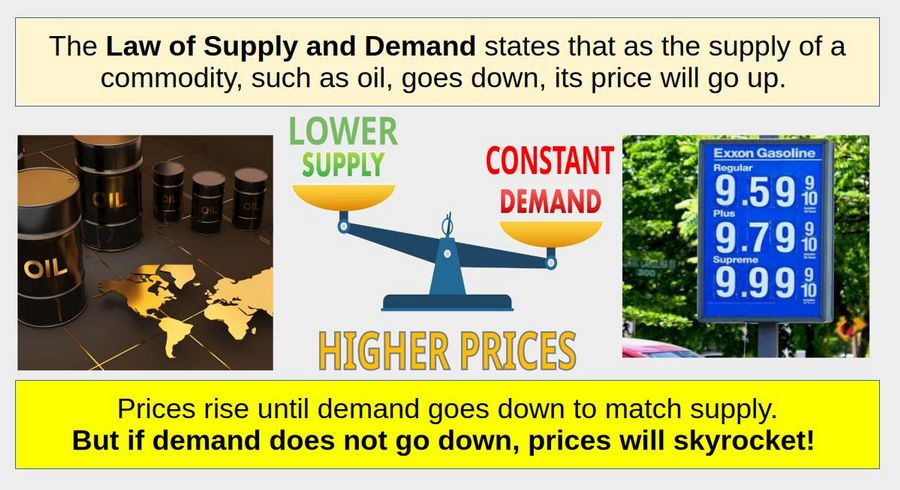
But what if the product is so essential that it is nearly impossible to reduce the demand because our entire economy depends on it? In the case of oil, it is essential not only for gas for our cars so we can get to work, but it is also essential to run trucks to bring food to our grocery stores. It is also used to heat our homes and power our electric grid. It is also used to run our planes and cargo ships. It is also used to create fertilizer to grow our food and is even used to create not only our clothing, but also the “chips” that run our computers!
Imagine that you lived in a community with 100 people and that each person needed a glass of water every day to stay alive. Now imagine that it cost a dollar per glass to for the Water Company to dig a well and pump this water out of the ground and bring it to your home. Imagine that for many years, the Water Company was able to pump exactly 100 glasses of water from their well. The price would remain the same.
Now imagine that something goes wrong with the well and suddenly the Water Company is only able to pump 90 glasses of water out of the well. What would happen to the price? The price would not merely go up 10% to match the 10% reduction in supply. Instead, the price would go up to as much as the richest 90% of community members could afford. Meanwhile, the poorest 10% would be left with no water at all. In short, scarcity of an essential product leads not just to rising prices but to skyrocketing prices.
Despite all of our attempts to conserve energy, oil consumption in the US has remained relatively constant. In the 1970’s to 1990’s, US oil consumption was about 18 Million Barrels (MB) per day. From 2000 to the present, it has been about 20 MB per day. What has improved is energy usage per person. In 1975, the US population was 216 million and today, 50 years later, the US population has increased by 60% to 345 million.
1973 to 1974 OPEC Oil Embargo compared to today
World oil consumption in 1974 was about 60 MB per day compared to 100 MB per day in 2026. In October 1973, Arab oil producers placed an embargo on a group of countries led by the US over their support for Israel during the Yom Kippur war. In addition, OPEC countries cut oil production by about 4 MB per day – or about a 7% reduction in world oil production. The result was a nearly 400% increase in oil prices or quadrupling of oil prices within 3 months. Both the US and UK had recessions that lasted from 1974 to 1975.The price of a gallon of gas increased by about 300% from 33 cents 1970 to $1.22 by 1980.
The lesson from the OPEC Oil Embargo is that a 7% reduction in world oil production can lead to a 300% increase in the price of a gallon of gas. We are currently dealing with a 10% to 15% reduction in the world supply of oil. The problem today is at least twice as bad as the 1973-1974 oil embargo. There are moderating factors including the fact that the US is producing more oil than in the 1970’s. However, there are also other negative factors.
These include that Russian oil is also being blocked. Other problems include Canada now in the process of using their new Trans Canada oil pipeline to ship oil to Asia rather than to the US – and both Mexico and Venezuala reducing oil exports by a million barrels of oil a day.
It is the combination of all of these factors that have led oil inventories in the US to reach their lowest point in years.
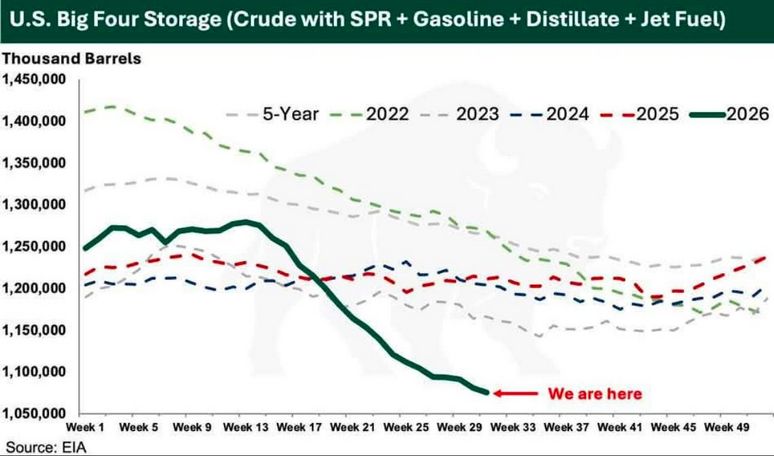
When all of these factors are added together, it is likely that gas prices in the US will at least double and could even triple. But it will not be just gas prices that go up. It is the price of nearly everything that is made with oil. Below is a graphic of just some of these items.
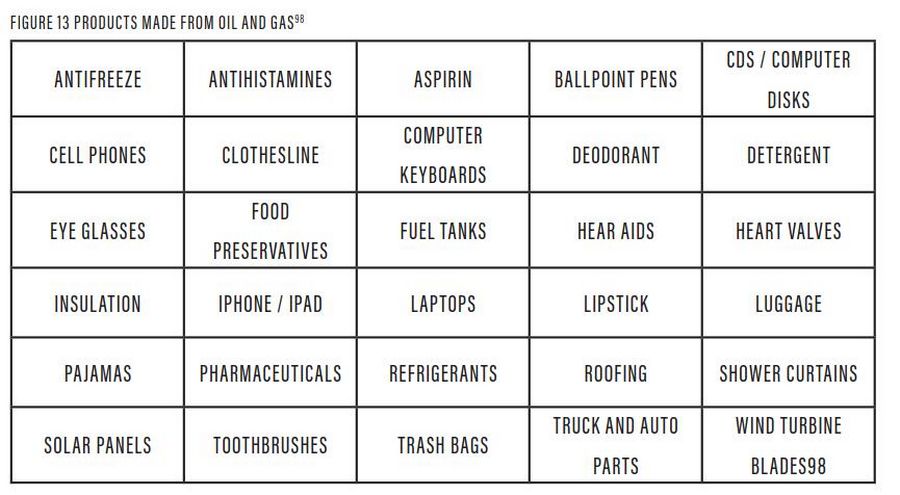
As all of these items go up in price, inflation will also go up, which will eventually affect everything. The biggest problem will be huge increases in the price of food – a topic we cover in detail in a later section. Once the SPR is gone, at some point in the future, we will need a more reliable SPR. Hopefully, we will have learned from this painful mistake do use steel tanks for oil storage rather than using cheap but unreliable salt caverns.